Factory / Builder
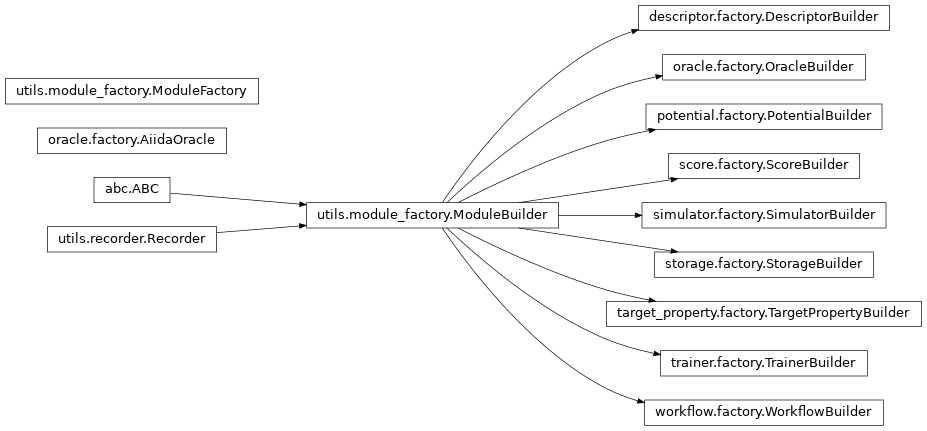
In order to facilitate the modular and interchangeable design approach of the Orchestrator modules, we provide class factories and builders for instantiating concrete classes in a uniform manner. There is a single generalized ModuleFactory class which is invoked and specified in each independent module as:
oracle_factory = ModuleFactory(Oracle)
oracle_factory.add_new_module('QE', EspressoOracle)
Note that the factory function arguments are classes themselves, not instances
of classes. While a single module factory could be used across the board, we
define specific factories based on the abstract base classes of each module, to
avoid possible naming conflicts (such as a LAMMPS oracle and LAMMPS simulator).
The available concrete modules are added to the factory using the add_new_module() method. Classes can then be instantiated using module-specific builders, based off of the abstract base
class ModuleBuilder. Users and
other modules will typically only need to interface with a builder, unless they
are creating a new concrete class that they would like to add to the factory.
At the end of every factory.py file defined by each module, a standard
builder is created which can be imported and used across the Orchestrator:
oracle_builder = OracleBuilder()
...
from orchestrator.oracle import oracle_builder
The builder and factory classes provide a common interface from which specific and concrete implementations of the modules can be instantiated, where the only change of code needed to switch to a different implementation is passing a different token to the builder:
instantiated_oracle = oracle_builder('QE', oracle_creation_arguments)
See the full API for the module at General Factory and Builder Interface.
Inheritance Graph